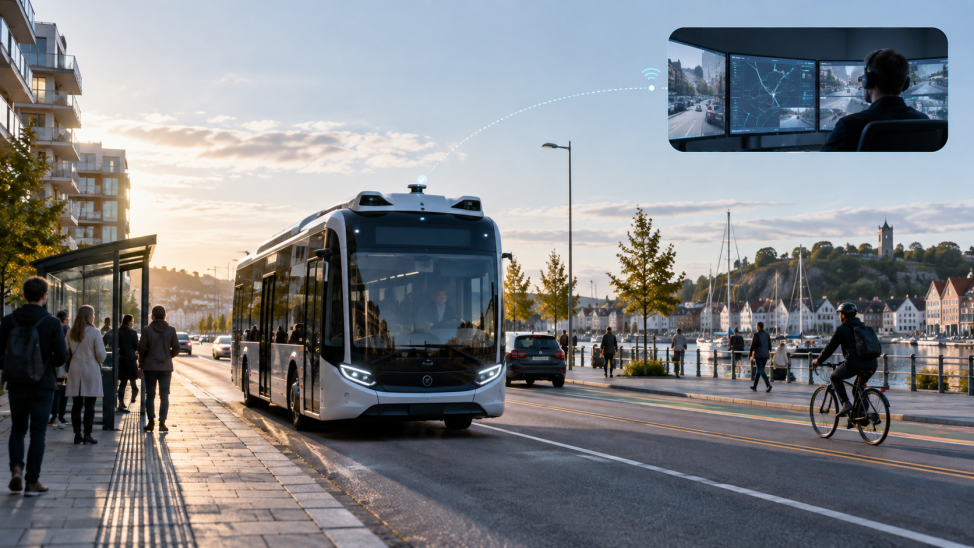
The autonomous bus operating in Stavanger has reached an important milestone. Norway’s Public Roads Administration has granted permission for Vy and Kolumbus to operate a Karsan autonomous e-ATAK bus on a regular public transport route without a safety driver behind the wheel. The vehicle uses autonomous driving technology from ADASTEC, while MMILE partner Applied Autonomy provides the xFlow platform used to monitor and manage the service remotely.
The approval marks a significant shift in the development of autonomous public transport.
For years, many autonomous bus projects have operated with a trained safety driver sitting inside the vehicle, ready to intervene if necessary. This has been essential for testing technology safely, but it also means that the operating model remains close to conventional public transport.
Removing that role changes the equation.
From autonomous driving to autonomous operations
The Stavanger project has been developing step by step since 2022.
The full-sized electric bus has already been operating in mixed urban traffic, carrying passengers as part of the Kolumbus public transport network. In 2023, the service moved to a more demanding route including a tunnel, higher speeds and a double-lane roundabout.
The latest phase focuses on something different: how to operate the service when the driver is no longer physically present in the vehicle.
This requires much more than autonomous driving software.
Operators still need to know where the vehicle is, understand its status, communicate with passengers and react when something unexpected happens. Instead of placing one safety driver in every vehicle, these functions can increasingly be handled from a central operations centre.
Applied Autonomy’s xFlow platform acts as this operational layer. It allows autonomous vehicles to be monitored and supported remotely, with the longer-term possibility of one operator overseeing several vehicles rather than one person being assigned to each bus.
That change is fundamental to whether autonomous public transport can move beyond individual pilots.
The real challenge is the operating model
Autonomous mobility is often discussed as a vehicle technology challenge. In practice, deployment also depends on operations, regulation, passenger experience and interaction with the surrounding transport system.
A human driver normally performs many tasks beyond steering the bus. Drivers answer passenger questions, respond to unusual situations and communicate with pedestrians, cyclists and other road users.
When the driver is removed, those functions do not simply disappear.
Recent work involving Stavanger has therefore also focused on how automated buses communicate safely with other road users. Human drivers often use eye contact or hand gestures in ambiguous situations, creating a new design challenge when no driver is visible behind the windscreen.
This is why the transition from a pilot to a real service is so important.
The question is no longer only whether the bus can follow its route. The question is whether the whole service can work safely, reliably and understandably for passengers and everyone else sharing the road.
Why scaling matters
There is also a strong economic reason for solving this challenge.
Public transport operators across Europe are facing shortages of professional drivers. Remote supervision could allow operators to support several autonomous vehicles from one location, helping services expand even where recruiting enough drivers is difficult.
But the strongest case for autonomy is unlikely to be simply replacing a driver with technology.
The larger opportunity is to create public transport services that would otherwise be difficult to operate economically: lower-demand routes, first- and last-mile connections, extended service hours or routes where conventional operations are too expensive.
That is where autonomy begins to change the public transport model itself.
From pilots to everyday mobility
Norway has been testing autonomous road transport for several years. Since 2018, the Norwegian Public Roads Administration has issued numerous permits for autonomous transport projects, ranging from buses to goods transport and winter maintenance vehicles.
The experience also shows why progress takes time.
Earlier autonomous bus trials around Stavanger demonstrated both the potential and the limitations of the technology. Low speeds, weather sensitivity and the need for an onboard operator all made it difficult to move directly from testing to scalable public transport.
The current Stavanger operation represents the next stage of that learning process.
For MMILE, this is exactly the type of transition that matters: moving beyond individual demonstrations towards solutions that can become part of everyday transport systems.
The milestone is not simply that a bus can drive without a person holding the steering wheel.
It is that the people, technology, regulation and operational systems around the vehicle are beginning to make driverless public transport possible as a real service.
And that is the point where an autonomous vehicle starts becoming public transport.