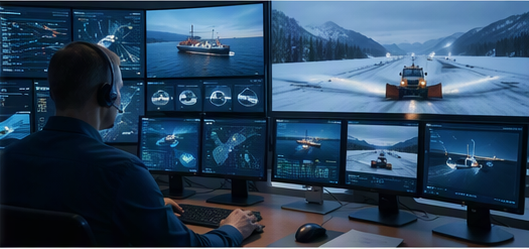
Remote operations are becoming an increasingly important capability in modern transport systems. They make it possible to manage, monitor, or support operations from a distance, using digital tools, sensors, communication systems, and human expertise. For mobility, maritime operations, and logistics, this creates new opportunities to address workforce shortages, improve service continuity, and increase resilience.
The potential is especially clear in situations where operations take place in difficult, remote, or safety-critical environments. For example, remote-controlled snow removal at airports illustrates how critical infrastructure can be kept operational even in harsh weather conditions or locations where personnel availability is limited. Similar principles can apply to maritime operations, logistics yards, ports, terminals, and other transport environments where reliability is essential.
Remote operations are not only about replacing local work with distant control. They can also create new operating models where human expertise is used more efficiently. A central control centre may support several sites, operators may supervise automated systems, and specialists may assist operations without needing to be physically present. This can improve safety, reduce downtime, and make services more flexible.
Within MMILE, remote operations form a concrete focus area because they connect technology, workforce planning, infrastructure resilience, and business development. Through collaborative testing and integration, partners can explore how remote solutions work in practice and what is needed for broader implementation. The goal is to ensure that remote operations strengthen real systems, not just individual demonstrations.